schrödinger's transsexual
or something about a paradox of representation

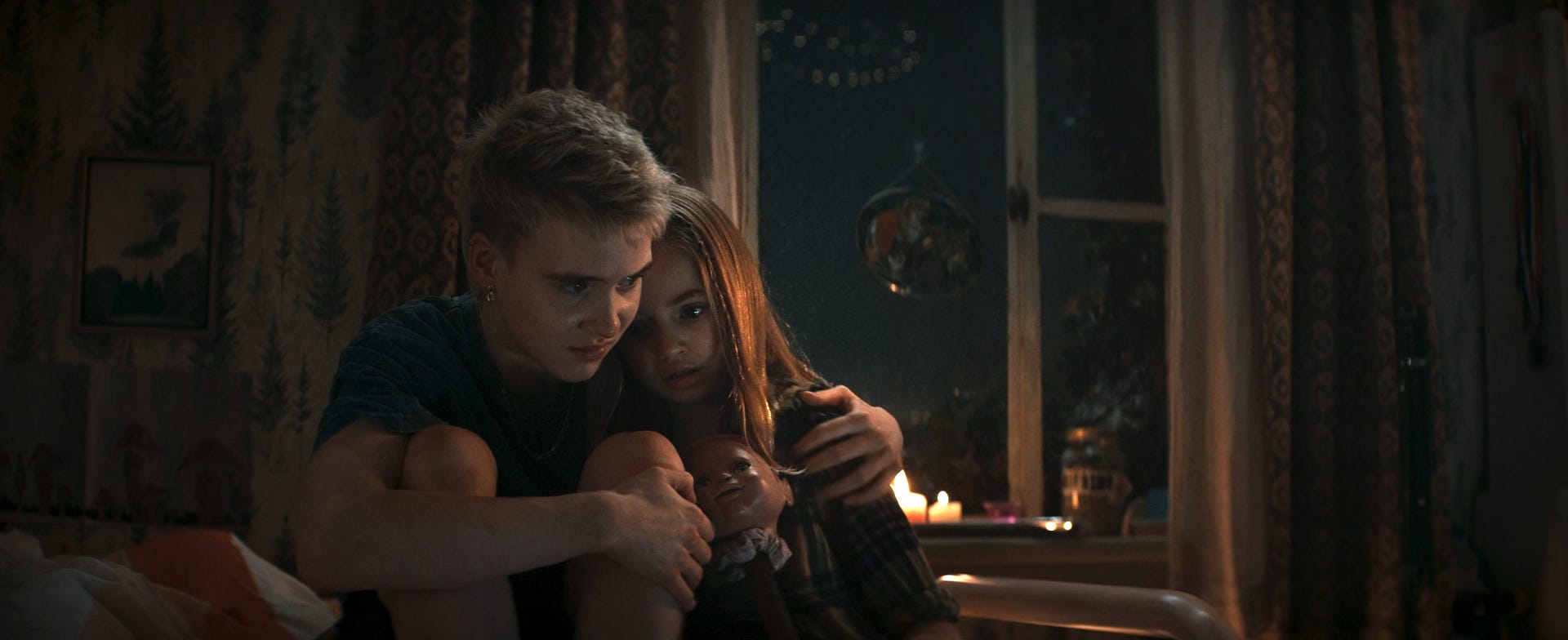
In Evil Dead Rise, the eldest son, Danny, is not a transsexual. But Danny is a transsexual. It’s complicated, and it depends on who you ask. Is Danny trans? Or is Danny just played by a trans person? Is there a material difference?
Fresh off of seeing the film at SXSW, I wrote about the experience of recognizing Morgan Davies as a trans person while also having to contend with the fact that the character was not likely written to be trans. And, listen. I love all of you. But having to listen to everybody’s opinions on trans* representation in horror and in the Evil Dead franchise is killing me. Most of you are not experts and in fact many of you are haters!
Nevertheless, the always-declining state of Twitter has meant that I’m seeing plenty of hot takes from folks that I would not ordinarily see. Plenty of folks have posed the same question that I failed to answer in my own initial review: how do we understand Danny’s trans identity? Or lack thereof? One of the tweets I saw recently was actually incredibly assertive on what the right answer is:
I think it’s perfectly reasonable to assume that characters played by trans actors [are] trans themselves unless explicitly stated otherwise. we always assume characters played by cis actors are cis, i don’t see why that should be any different for trans characters.
For what it’s worth, trans actors playing cis roles is not even remotely a new phenomena. Like at all. It’s a contemporary phenomena with out actors (including Nicole Maines and Liv Hewson in Yellowjackets) and an older phenomena with closeted actors (see Caroline Cossey and Ajita Wilson). We’re more cognizant of it now because more people seem to be in search of True, Authentic Representation in every sense of the term. I’m part of this movement whether I intend to be or not; many of my Patreon updates are keeping tabs on what roles trans actors land, even though many of them are not playing “transgender roles”.


I am less concerned with this question of “representation” on a micro, character-by-character level than I am with its larger implications. There feels like a disconnect between the sentiment of “we always assume characters played by cis actors are cis, i don’t see why that should be any different for trans characters” and the sentiment being expressed by multiple trans actors, who, at the risk of sounding like an absolutist, seem to be in direct opposition to that line of thinking.
From Morgan Davies: “I also want to play characters who are not trans, I don’t want my career to revolve around my transness.” From Lachlan Watson: “I love playing non-binary characters, I love playing transgender characters, and I also love playing cis characters […] I don’t necessarily feel the need to limit myself to just characters that identify the way that I do”. From Zoe Terakes: “I don’t go into any role thinking about their gender.” There was a brief period where Hari Nef seemed almost hostile toward being identified as a trans artist (although that no longer seems to be the case; this snippet from her about “dolls” is already one of my favorite pieces of writing from this year).
I’m not highlighting these quotes to imply that there is an assimilationist desire amongst this new wave of trans actors. I am not implying that these actors are all racing to as many cis roles as they can snatch (although, I think if they all coordinated on this point, trans actors could go and do something very funny). There are plenty of actors and casting directors who seem to be actively seeking transsexual voices and stories (yes, Zoey Luna’s character in The Craft: Legacy was trans from inception), and almost all of the above quoted have played their share of cis and trans roles. They’re actors. Not all roles are written for their specific identity. That’s showbiz (or so I’m told).
But I pull from this article as well, ‘Why Evil Dead Rise & Yellowjackets’ Trans Inclusion Is The Future’:
“Chances are you didn't hear anything in the lead-up. No big marketing pushes, no big reveal on screen. That they arrived with little fanfare is exactly what made it so notable. That quiet, casual approach to transgender inclusion is exactly what makes it so radical and sets a blueprint for the future of non-cis representation in media.”
And I suppose that is the question I come into this piece wanting to figure out: is this the kind of representation we (colloquial) want? The representation we need? Is it “good enough” to have a trans person onscreen, because the transsexual audience will recognize the transsexual actor? Is this The Future Of Non-Cis Representation?
It’s hard to gauge what the general consensus is on something like this. For example, Morgan Davies: there are plenty of comments online decrying Evil Dead Rise as transsexual indoctrination propaganda because of his casting. The actor is trans, ergo there are estrogen hypos hidden in your popcorn. But there are just as many comments which boil down to “oh, that kid’s trans? I had no idea. Good for him”. I even completely forgot that I told my parents about there being a trans kid in Evil Dead Rise until we were watching it the other day, and my dad asks me: “Now, is she a trans woman? Or is he a trans man?”
Point being: recognition of a trans actor is not a given. A transsexual audience might recognize the actor, and it seems like a total crapshoot whether or not the cisgender audience will manage the same. Thus I find it hard to wrap my head around that so many people are calling it a #win for #representation.
Does it matter if Danny was ever written to be trans, like The Craft: Legacy’s Lourdes was? There’s an argument for both yes and no answers. I think that both characters in this example can be analyzed to a similar level of depth. However, that’s because each character’s transness is at roughly the same level of acknowledgement (re: very light, if textually present at all). Neither character says anything about the transsexual experience. There’s no indication that their transness informs their actions throughout their stories.
Does this not feel frustrating to anybody else? To recognize the transsexual self being reflected back at you, only for that recognition to remain unspoken? Or is that on “us” for reading too far into a creative decision that was maybe never intended?
One aspect that I find underexamined in this micro-discourse is that of the subject matter of the stories. I think we can bounce back and forth all day long about what roles should be played by what kind of people, but I think this presupposes that we have already had what I jokingly refer to as The Great Renaissance of Transsexual Stories. We most certainly have not. We seem to have skipped it entirely: we’ve gone from stories where the transsexual is placed upon the pedestal of the Strange Other, who must be demystified and shown to be Just Like You, and we’re currently in the stage of explaining why it’s good, actually, that trans people are able to play roles that are not loud-and-proud Transsexual. Are these previous loud-and-proud Transsexual characters in the room with us now? Can you point them out of the lineup for me?
Horror (and the broader cinematic landscape, of course, but I stay in my lane) is not overrun with portrayals of transsexuals-by-transsexuals (TBT?). There are roughly only 18 feature-length horror films that fit that criteria. Only 10 can be argued to have trans “main characters”. None of those films are more than 15 years old; Ticked-Off Trannies With Knives is the oldest, released in 2010.
I guess that is part of where my confusion stems from. Sure, even at it’s absolute laziest, the mere insertion of a transsexual character into a conventional story can still be groundbreaking. But that’s only scraping the untapped potentiality. Consider the stories that you can only tell with trans characters. Where are the romantic, sappy love stories? Explorations of the horror and wonder of body alchemy? Murder mysteries? Sex comedies? Sports movies? Can we get a T4T Face/Off?
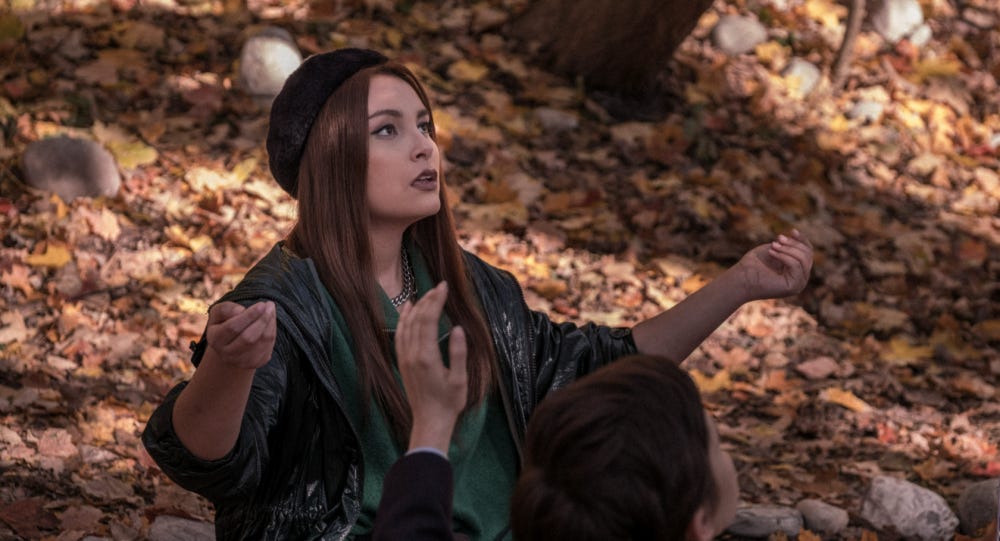
I do not necessarily intend to cast shame or frustration on the creators behind films like Evil Dead Rise and Talk To Me, but it feels completely bizarre to me that some are applauding them for bringing in some new “era” in representation. I’ve seen both films; neither Morgan Davies’ nor Zoe Terakes’ characters are ever even referred to by a single pronoun. How do you classify that?
Do you default to creator intent? If they were written cis to begin with, do they remain cis despite a trans actor’s portrayal?
Or, assuming death of the author, do we subscribe to the idea that a visual recognition of a trans body equates to some form of representation, regardless of writing that never attempts to broach the topic? Does our transness override all else?
Although Talk To Me has yet to be released, I have been contacted by multiple people in relation to how the directors purportedly treated Terakes on-set. These allegations are not public and I won’t discuss them at length, but their accuracy is almost besides the point. It already makes me very wary to see films touted as “trans-inclusive” or “trans-positive” for the very simple act of casting a trans actor, but I think that line of reporting inevitably ends with praise being heaped upon transphobic opportunists.
It should also be said that these accusations are anomaly among Talk To Me’s peers: Evil Dead Rise, Yellowjackets, There’s Someone Inside Your House, The Craft: Legacy, They/Them, and Chucky have not garnered the same whisperings. But this is nevertheless an angle to the conversation that ought to be considered. When one asserts that trans actor = trans character every time, does that not suggest an incredibly simple, lazy way for filmmakers to earn praise? Nobody has to actually write trans stories or characters; just cast a trans actor and the audience will do all of the work for you?


It feels like we are less focused on the trans actor than we are on the cisgender creator. It’s the same thing that makes my eye twitch whenever people assert Cronenberg as the Daddy of Trans Horror. First of all, he isn’t (that’s a title of contention), and just being inspired by trans people feels increasingly lame as the years go on. I can’t argue against the iconography of his use of trans imagery (which seems to have been passed onto his son, BTW), but I cannot heap praises upon it.
What’s the fascination with exploring trans identity without the trans person? Likewise, why is it such a great thing that we aren’t seeing an equal rise in trans characters as we see more trans actors breaking out?
Although I (clearly) have my opinions, I don’t exactly seek to answer the question of how we “should” understand this type of trans representation. I don’t think there is one answer that will fit many or even some of the examples I’ve listed. But I would broadly say that I don’t think we’re using the right language in discussing the issue. I don’t think that actors are tired of playing trans characters (can you imagine a world?), more that they are tired of the same trans characters. The Introductory Transsexual, sent out into the world to show that we trannies put our pants on one leg at a time, just like you! I think that’s where the disconnect comes in, where (queer) audiences will identify a trans actor and thereby read the character as trans, despite the fact that the role was not written with transness in mind and the actor is just… acting!
I agree with the sentiment that transsexuality should not define a character, but I believe it should at least inform it. I promise that no matter what stealth transsexuals have told you, there’s not a day that goes by where my transness doesn’t factor into something. Whether it’s going to the bathroom in a public place or just trying to relate to people of the same/opposite sex as me, my transness is there. It informs how I act and where I go, and it would certainly inform me if I were in a horror film situation.
To briefly acknowledge the cultural mammoth in the room, I understand why were are where we are. Things are fraught. Although I do not entirely agree with it, I empathize with the desire to put art out into the world that humanizes transsexuals. As if one good episode of Yellowjackets might turn the political tide, you know?
But, selfishly, I am tired of seeing art sacrificed for the sake of humanizing us to a section of the population that’s never going to see us as anything other than shit on the bottom of their shoe. I don’t think it’s brave or especially exemplary that cisgender men take inspiration from the transsexual without including us in their art. I don’t think it’s brave for a film’s creatives to remain silent on any trans text that could be found in their film. Because it’s not even that these characters are always explicitly cis, it’s that they’re so goddamn nebulous.
Does Evil Dead Rise have trans representation? Is Hayley trans in Talk To Me? Will Hunter Schafer be playing a trans woman in the upcoming Cuckoo? Is Pinhead trans now, because she’s played by Jamie Clayton? Are both Bobbi Menuez and Amandla Stenberg playing cis in My Animal? Will Brigette Lundy-Paine be trans in I Saw The TV Glow? Why am I seeing myself everywhere and nowhere? What funhouse mirror bullshit is this?
In an interview promoting the upcoming Dr. Jekyll adaptation starring Suzy Izzard, director Joe Stephenson said:
“There seem to be some assumptions that because Nina is a trans character, we are somehow going to make it about gender. That is not the case…”
Quotes like this break my heart. I have a vague sense of what Joe probably means, but it only speaks to that misuse of language that feels more like it’s shoo’ing away any sort of interesting transsexual take on the Dr. Jekyll story.
I do not think we’ve earned this fold in cinematic history where we pat ourselves on the back for shying away from a chance to shove our hands into the guts of what transsexuality can offer a story. Over the last year, we have had three films where a trans actor has a major role in a possession narrative— Evil Dead Rise, Talk To Me, and Dr. Kim Hunter and the Apparition— and none of them do anything with that. Seriously? Nobody can write a transgender possession film? Nobody wants to take that? No interviewer cares enough to ask the question, no filmmaker cares enough to bring it up on their own?
It is okay for things to be about gender. It is okay for trans stories to be about gender. I am going to be bold and say that our stories should be about gender. I do think there is a material difference between just casting a trans person and creating a transgender character. And I think I’m tired of letting (overwhelmingly cisgender) creatives get credit for “representation” that feels increasingly nebulous and intangible.
It’s Schrödinger's transsexual: we have so much representation, and yet we have none. Danny is a transsexual, and so is Hayley, except that they aren’t. Neither character says a thing about the experience of transsexuality except for what we project onto them. Transsexual skin stretched over a faceless mannequin. What a great cultural moment.